All posts by admin

R&D BringToLife

We began this research for this exciting project in 1993, with the initial focus being on the modeling qualities of performance art. Inevitably, We have adapted and applied this solution to serve the music production market. With the new software BringToLife™, VSTLive tries to make MIDI productions sound as human as possible.

The Challenge:

Explaining what makes a certain performance sound good is much harder than explaining what makes it sound bad. That’s exactly what VSTLive team does. We simply listen to the great performances and try to answer the hard question. Then, we update the model to consider some new performance qualities or we simply update the solution/parameters with more accurate values.

CONTROLING THE CONTROLLERS: There is no way to control the MIDI controllers simultaneously and precisely. VSTLive solution “BringToLife™” does this automatically.

  • CONTROLING EXPRESSION: There is no one optimal envelop that can be applied to all notes. Our system draws MIDI expression events while considering envelope parameters i.e. attack, hold and release, so each note will get the appropriate envelope and expression accordingly.
  • CONTROLING VELOCITY: Velocity needs to be adjusted in order to make a musical phrase sound natural and homogenic. Our algorithm calculates how loud or soft each note should be played according to its context.
  • CONTROLING KEY SWITCHES: Today, with more CPU power, memory and storage available, 40 or more different recordings can be organized to serve a single note. This makes it abundantly clear that in order to map an instrument, we may ultimately end up with thousands of samples in order to deliver the quality of coverage desired. Our algorithm controls key switches including velocity correction.
  • CONTROLING PITCH BENDING: Slides on a bowed instrument can be done using the Russian slide or the French slide among other styles. We keep in mind that many other parameters must be considered in addition to choosing the appropriate pitch bend mask.
  • CONTROLING TIMESTAMP: Some producers process quantization with randomness to get a humanized effect. Our system may add forward or backward offsets to each MIDI note according to the melody analysis product.

The Solution: BringToLife™ is a SaaS (software as a service) that analyzes and processes MIDI tracks on different virtual instruments (sound libraries) to make them sound as human as possible. Our solution considers hundreds of cases and can make similar intuitive decisions that experienced musicians would choose.

Example 1: Johannes Brahms | Violin Sonata No. 1 in G major op. 78 Julia Fischer – Adagio/Più andante

Example 2: Johannes Brahms | Violin Sonata No. 1 in G major op. 78 Julia Fischer – Adagio/Più andante

Roadmap: We are planning to focus on middle east musical instruments: A musical instrument is designed to support a specific music style. We believe that virtual instruments should consider many factors behind sound. For example, most Oud (Arabic instrument) and other middle eastern instrumentalists do not play their parts as originally written, but they add their own interpretation including ornaments and even new notes.
YaAlef 2.0.0

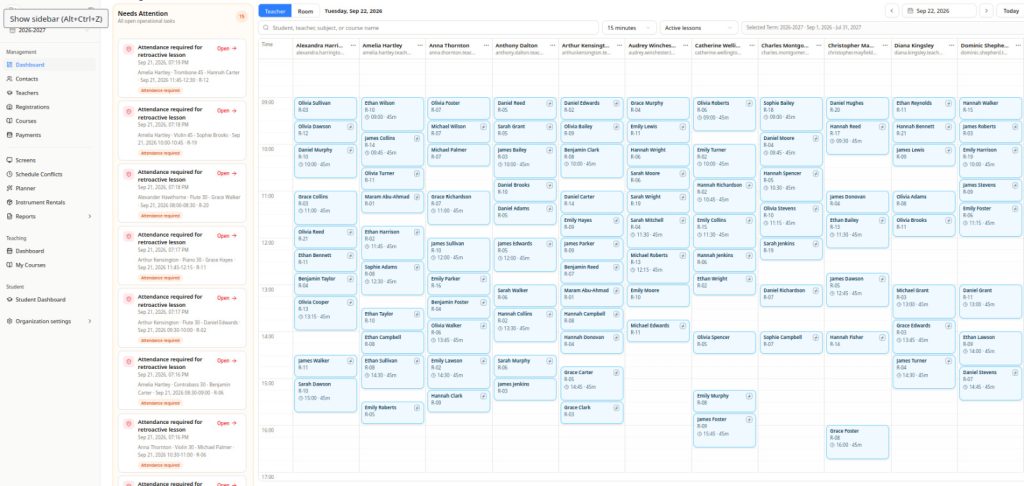
A modern web-based system designed for music academies, conservatories, and educational music institutions. The system helps management teams organize students, teachers, lessons, attendance, payments, reports, rooms, and daily administrative work in one professional platform.

YaAlef 2.0 Dashboard

Key Features:

  • Organization & academic setup: organizations, organization switching, setup/readiness workflow, permissions, organization timezone, Main Term/sub-terms, working days/hours, term exceptions, scheduling settings, and multilingual/RTL operation.
  • People & relationships: students, guardians, teachers, employees, large searchable people lists, guardian relationships, copying guardians between siblings, identity/contact details, profile pictures, and people import workflows.
  • Subjects & course catalogue: subject catalogue separated from actual teaching, course variants, course-specific commercial/scheduling properties, default course fees, naming/renaming courses, and course configuration.
  • Registrations: student registration into course variants, assigned teachers, payment contracts, scheduling from registration, registration lifecycle/end participation, group vs. private participation behavior, and preservation of historical/financial records when participation ends.
  • Private & group course scheduling: multi-stage private scheduling, teacher availability/committed times, weekly scheduling, rooms, conflict validation, term restrictions, course lesson counts, manual lesson addition, moving/swapping lessons, teacher/room changes, and modified-lesson indicators.
  • Lesson lifecycle: active lessons, cancellation/reactivation, rescheduling, course cancellation, preserving cancelled lesson history while removing it from the operational calendar, availability/conflict release, and course/lesson detail views.
  • Make-up lessons: make-up requests and a dedicated scheduling workflow using the original lesson, same-time future opportunities, teacher availability, freed cancellation slots, room validation, and manual fallback scheduling.
  • Teacher App: mobile-oriented dashboard, Today/Week views, attendance entry, missing-attendance alerts, lesson notes, lesson opening/details, restricted cancellation permissions, localization/RTL, and teacher schedule interactions.
  • Attendance: per-student attendance for groups, attendance states, prevention of future attendance entry, missing-attendance tracking, teacher completion monitoring, and management reporting.
  • Teacher agreements & workload: teacher contracts, Main-Term-derived dates, committed weekly slots with multiple ranges, teacher availability, and teacher salary reporting.
  • Finance & payments: registration payment contracts, commitments, course-variant default fees, payment-plan concepts, searchable commitments, partial payments, one payment across multiple commitments, multiple payment methods, multiple cheques, payer-name suggestions, allocation handling, returned cheques/failed transactions, effective outstanding balances, payment voiding, and unofficial payment PDFs.
  • Management reporting: student balances, teacher salaries, management summary KPIs, collection rate, outstanding/overdue amounts, attendance and cancellation rates, teacher activity, student/teacher rankings, lesson operations, registrations/course metrics, and “Needs Attention” indicators.
  • Notifications: PWA/mobile push infrastructure, multiple devices per user, localized notifications, deep links, lesson cancellation/reactivation, rescheduling, room/teacher changes, new/make-up lessons, and grouped notifications for bulk course operations.
  • Lesson contact access: lazy-loaded contact information directly from Lesson Details for student, guardians, and teacher, with clickable phone/email values and permission enforcement.
  • Rooms: room management, capacity/details/accessibility information, room scheduling, room weekly views, and room conflict checking.
  • Instrument rentals: a dedicated instrument rental management module with instrument/request/rental-related workflows.
  • Dashboard & displays: operational dashboard/day views, large-screen/TV optimization, paired displays, display management, compact lesson cards, and responsive schedule behavior.
  • Localization & accessibility of the UI: Arabic/Hebrew RTL, English/German localization, proper direction inheritance, date formatting, translated reports, mobile/tablet/PWA optimization, and safer/less intimidating destructive-action UX.

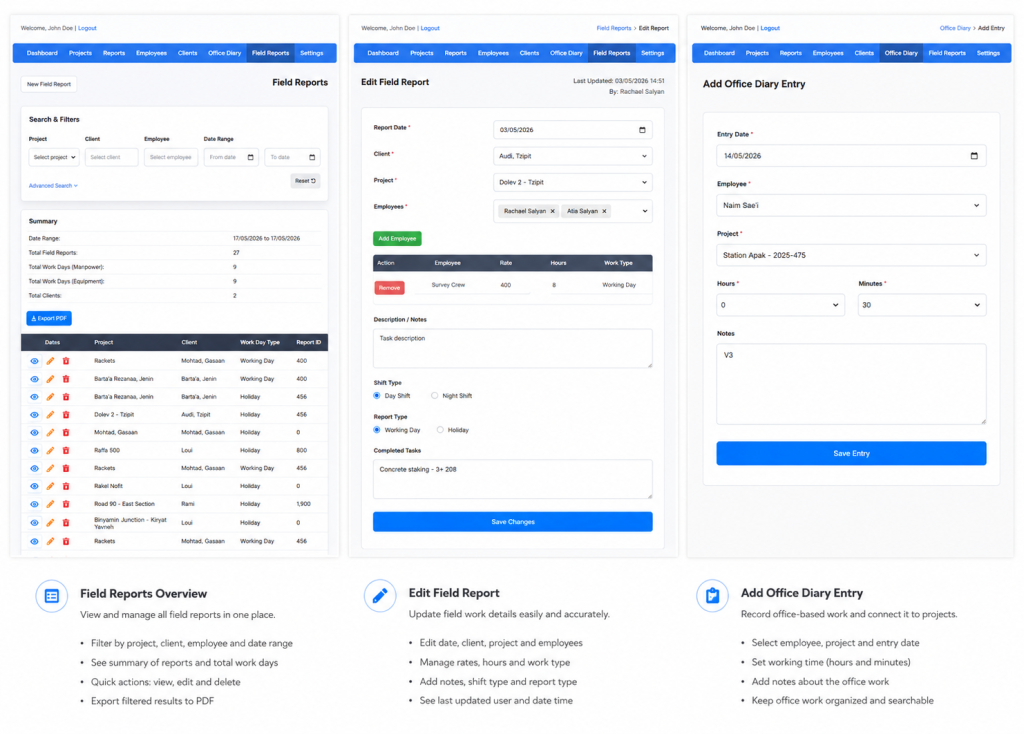
Field Operations Management System

The Field Operations Management System is a web-based system for surveying and service-based companies.

It helps companies manage projects, field diary reports, office diary reports, employee work, services, monthly working days, and PDF reports in one organized place.

The system gives managers a clear view of daily activity, reported effort, and project documentation, while keeping the reporting process simple for employees.

Contact

For more information, contact us via our business WhatsApp account VSTLive Support 972-52-701-1940.

Conservatory Management System

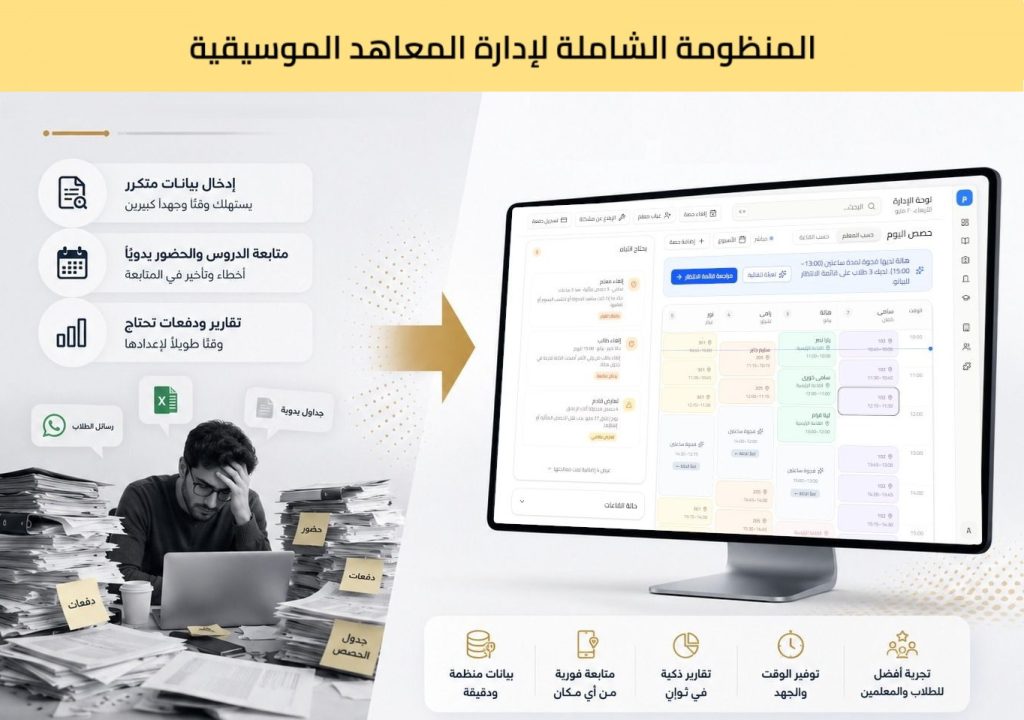
A modern web-based system designed for music academies, conservatories, and educational music institutions. The system helps management teams organize students, teachers, lessons, attendance, payments, reports, rooms, and daily administrative work in one professional platform.

The goal of the solution is to reduce repetitive manual work, improve communication between administration and teachers, and provide managers with clearer access to the information they need for daily operations and long-term planning.

Conservatory management system mockup
Conservatory management system (Arabic version)

Key features:

  • Student and teacher management
  • Lesson scheduling and attendance tracking
  • Administrative reports and progress monitoring
  • Room and resource organization
  • Payment and lesson follow-up
  • Teacher lesson reports and comments
  • Compatible with smartphones, tablets, and desktops
  • Designed for music academies and conservatories

Who is it for?
This system is designed for music academies, conservatories, private music schools, and cultural education institutions that manage students, teachers, lessons, attendance, payments, and reports.

Taskoria™

Taskoria is a lightweight Team Management System for managers who run multiple projects simultaneously. It helps organizations manage teams, assign tasks, follow progress, and keep project information organized in one central workspace. The system is designed for small and medium-sized organizations that need a clear, practical, and flexible tool for daily project coordination.
With 0Bab, managers can track task status, review team activity, identify warnings, and keep all related information connected to the relevant task or project. The system supports file attachments, rich text editing, tags, and dashboard indicators, making it easier to manage priorities, risks, and follow-up actions.

Taskoria is compatible with smartphones, tablets, and desktop computers, allowing users to stay connected whether they are in the office or working remotely.

Designed according to modern security practices

Key features:

  • Team management and task assignments
  • Multi-project task organization
  • File attachments and rich text editing
  • Dashboard with progress and warning indicators
  • Tags for risk management, priorities, and internal classification
  • Optional language localization
  • Responsive access from smartphones, tablets, and desktops
  • Practical interface for small and medium-sized organizations

BringToLife (Research)

Key Features: 

  • Drag and drop your MIDI track directly from your DAW to our cloud
  • Wait few seconds and our system will make your phrases sound as human as possible
  • Drag and drop your processed MIDI track back to your DAW
  • Calibrate your sound libraries
  • BringToLife™ is designed for violin, viola, and cello.
  • Specific presets to support commonly used libraries;
  • Matrix view to indicate issues;
  • Advanced instrumentation analysis and automatic error resolution.

Thirty years ago, three or four different recordings of an instrument were distributed across one octave, which meant that mapping an instrument was limited to approximately 16 samples. But we now know that a single instrument produces thousands of samples and millions of variations. This succinctly illustrates the fact that the coverage of instrument mapping or ‘modeling’ was very poor at that time.

Today, with more CPU power, memory and storage available, 40 or more different recordings can be organized to serve a single note. We now understand that every single pitch can be played with 10 or more key switches, at 5 or more dynamic levels. This makes it abundantly clear that in order to map an instrument, we may ultimately end up with thousands of samples in order to deliver the quality of coverage desired.

Of course, it is now also possible to arrange a single phrase and make it sound considerably more realistic. However, the point is that choosing the appropriate sample for each note is hugely time-consuming. It can take a vast amount of time to add bending, expression, modulation and other desirable midi controls.

Are you really familiar with the instrument that you’re playing? Did you know that trills on C# and D# sounds terrible on the side flute? Did you know that the bassoon cannot produce soft phrase at the low register? Do you really completely understand the qualities of each and every instrument?
VSTLive does…so why not just choose an instrument from your sound library, play your part, then let us do the job?!

MAJOR™

Program for GPS Network adjustment, transformation and user defined regulation.
As the different types of cadastral points have their own methods of measurement, coordinate computation and quality assurance criteria, In order to obtain a license from the surveying authorities, this software allows surveyors to define the measuring method (which includes the observation net architecture and quality assurance criteria for the measurements), as well as the computation method of each cadastral point type (which includes net adjustment, transformation, results quality assurance, and final report format). The software executes all this process automatically with informing the user about the results of every step till generating the final report for submitting to the surveying authorities.

Main Features:

  • Gross Error Detection method (using Statistical testing & Loop misclosure)
  • Licensed point library.
  • Least Square Adjustment engine.
  • RTK reliability assurance method.
  • Transformation method.
  • Method for calculating Cadastral Boundary points.
  • Regulation and Quality Assurance.
  • Smart Formal Report builder.

Design Consideration:

  • The Major 1.0 has exceeded the design bounds, and was redesign several times as a result of deep research while the development process, 
    Layering the system architecture and partition it into subsystems was necessary to control such huge project.
  • Planning for change 
  • The project was developed using the VB environment aware to its advantages and limitations.

Coordinate Transformation Tool™

Program for common GPS transformations for geodetic uses. it enables survivors to Fit their GPS measurements from the WGS’84 Datum to any Local Datum in the world.

Main Features:

Transformation Model

  • This Software Application calculates the Spatial Transformation Parameters using the Least Square Adjustment Method in order to fit the GPS measurements to a specific datum.
  • It supports different file formats for Input and Output.
  • It offers a Transformations Model for using RTK.
  • The application automatically separates the control points from the input, calculates the unknown points coordinates and prints these in the reports.

Least Square Undulation Model

  • This software application calculates a Local Undulation Model  N= H-h. H indicates an Ellipsoidal Height, h indicates an Orthometric Height.
  • The calculation is based on Least Square Adjustments Computations.
  • Undulation might be a plane formula, parabola or polynomial.
  • The application automatically separates the control points from the input, calculates the unknown points’ Orthometric height and prints it in the reports.

Design Consideration:

  • The project was developed using the VB environment aware to its advantages and limitations.
  • Planning for change, The GEO-GRID OCX component was developed especially for the CTT to and handle Surveyors GEO Data, such component can be used for future developments.

Tretone

Audio platform based on general MIDI sound generator.

We built platform for musical therapeutic instruments for people with special needs. The system is a biofeedback stand alone system that measures the grip force as an input and produces sound as an output.

The system includes display and control switches for browsing the different programs. The output sound is correlated with the input according to different predefined algorithms. The system is based on two chips and grip force sensors. The core of the system is a micro controller “TI MSP430”. The sounds are general midi sounds produced by a standard sound generating chip.

Design Considerations Noise:

The sound of the audio should be clean of noise which requires special attention in board design and in power supply design.
Memory size: The memory in the system is limited to 8Kbyte flash memory. Special care was given to optimizing the code. Real time sampling: The sampling of the inputs should happen at fixed times regardless of any parallel activity that the microcontroller is occupied with.
Product life time: The used components need to serve the project for at least 5 years and preferably 10 years.

The design was executed for Analog Tone LTD.

Vehicle Scheduling

Optimal Determination of vehicle schedules, based on Prof. AVISHAI CEDER research (deficit function bus scheduling with deadheading trip insertions for fleet size reduction). Technion, Haifa.

The buss planning process of a large-scale bus company involves complex and challenging tasks. starting with planning bus stops, planning bus routes, setting time-tables, scheduling busses, and assignment of drivers. Though it is desirable to consider and analyze these components. That is the outcome of each component, is fed as the input to the next one.

The software provides manual and automatic tools for transportation engineers to achieve better planning process and results.